
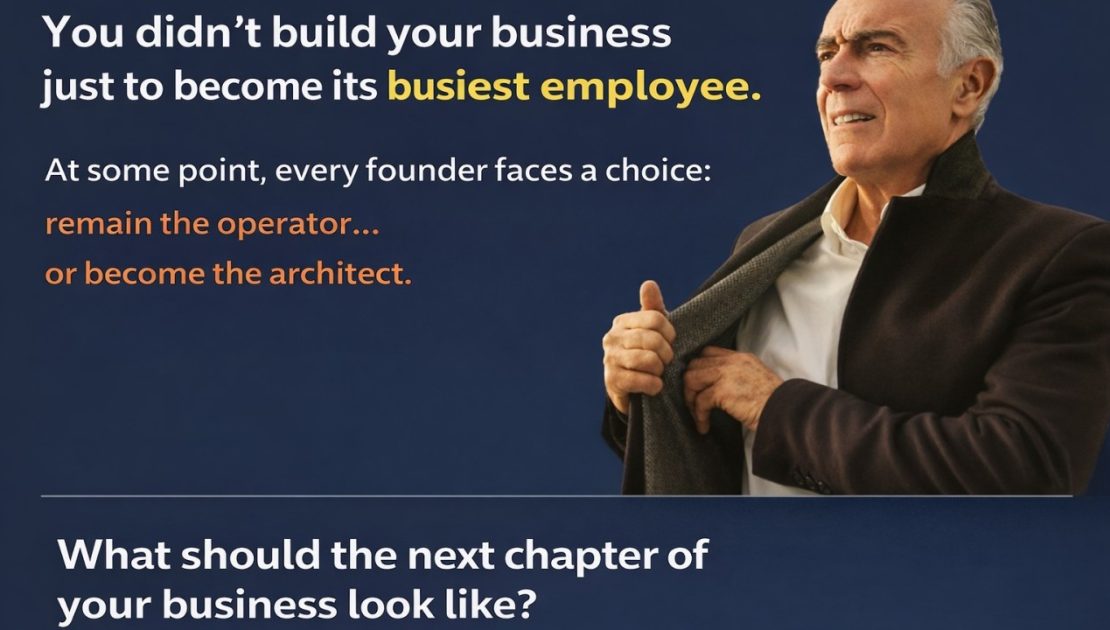
Yet for many founders, that’s exactly where the days disappear. Why?
Well it starts when the business is founded.
A founder with a good idea put together a game plan and some seed funding, rolls up their sleeves and gets stuck in selling, solving problems, delivering the product, managing the team, chasing invoices, fixing whatever breaks next.
In the early days, this works. In fact, it’s necessary. But something subtle happens as the business grows.
The founder becomes the busiest person in the company… and paradoxically the one with the least time to think.
Many successful business owners eventually discover they arerunning faster, but not necessarily moving forward.
Working in the business means living inside the day-to-day operations deaking with Client issues, Staff management, Deadlines and delivery, Emails and meetings
Endless small decisions
These things are important. They keep the engine running. But if all your time is spent here, something critical is missing.
No one is thinking about:
· Where the business is going
· What the next opportunity looks like
· Whether the strategy still fits the market
· How the company should evolve
And if the you as the founder are not doing that work… it usually doesn’t get done.
At a certain point, the role of the founder must change.
The business doesn’t need another operator. It needs a leader and architect.
Someone must step back far enough to see the bigger picture.
To ask questions like:
· What should this business look like in five years?
· Which opportunities are worth pursuing and which should be ignored?
· Where should we focus our resources next?
· What needs to change to unlock the next stage of growth?
These are not operational questions, they are strategic leadership questions.
And they require time away from the noise of daily operations.
Many business owners tell themselves:
I’ll focus on strategy when things calm down.
Unfortunately, things rarely calm down. Operational demands expand to fill every available hour.
The most successful leaders deliberately create space to step out of the business and reflect. Not because they have spare time — but because the future of the company depends on it.
If you’ve built something meaningful, you’ve already proven you can operate.
The next stage requires something different: Perspective, clarity and intentional direction.
Sometimes that simply begins with stepping back long enough to ask: What should the next chapter of this business look like?
And then designing the path to get there.
For assistance in designing that path click here…https://fiverc.com/management-consulting/introductory-evaluation-for-next-step/
#BusinessLeadership #Entrepreneurship #StrategicThinking #BusinessGrowth #FounderJourney #LeadershipDevelopment #BusinessStrategy #CEOMindset #ScaleYourBusiness #WorkOnYourBusiness
