
The other day I was doing some planning for an African based client which involved tying his game plan to his country’s. And a thought struck me, I wonder what the national vision is for South Africa…?
I asked some people in the know and was met with either confused silence or references to national plans, but not to any grand vision. I did some research and guess what, it doesn’t exist (my client’s country surprisingly also doesn’t have one).
No vision for the future state of this country has been formulated or published, certainly not one that unites business, government, and society.
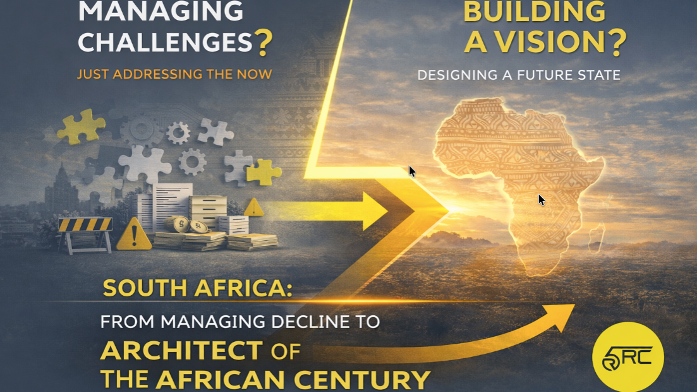
We have however become brilliant at discussing the latest challenges. We analyze, we debate solutions, and we implement “turnaround plans” and “strategic objectives” with the frantic energy of a man trying to fix a leaky pipe while the house is on fire.
But here’s the rub: solving immediate challenges, however necessary, is not a vision. It is crisis management. It’s administrative triage.
Great leadership understands that while challenges must be solved, they must be solved in the attempt to achieve a grander vision. A vision isn’t a spreadsheet or a slogan; it’s a declaration of a future state that inspires. It focuses the mind.
Right now, South Africa has a gaping vision vacuum, and frankly, I am sick of being fed a diet of compromised “acceptable” plans and political statement that have all the ambition of a lukewarm cup of tea.
How did we get here? Since 1994, we’ve tried on a few different “national hats.”
The Reconstruction and Development Programme (RDP) was our post-apartheid “Old Testament.” It was about redistribution and basic needs. Then came GEAR—the era of macroeconomic stabilization, which was essentially the government trying to convince the world we weren’t going to blow the budget.
Then, there were the big ones.
Nelson Mandela’s “Rainbow Nation” was our first real mythos. Some modern cynics claim it was too emotional. Rubbish. Whoever determined it was “too emotional” clearly doesn’t know South Africans. We are a people who feel deeply. We prefer to be led from the inside rather than from the top. We’re distrustful of braggarts and allergic to BS, but we’ll follow an honest, transparent, and direct leader to the ends of the earth.
Thabo Mbeki’s “African Renaissance” moved the needle toward an intellectual, continental focus. It gave us a role: the “Gateway to Africa.” It was sound, it was ambitious, and then it was derailed by a decade of “State Capture” and the kind of mismanagement that would make a Victorian headmaster weep.
So, where are we now? Under the Government of National Unity (GNU) and big business partnerships, the dominant narrative is about a “Social Compact” or a “Capable Society.” Let’s be honest: it’s a compromised plan. It’s “Business fixing the ports because the state can’t.” It’s pragmatic, sure. It’s functional, hopefully. But it’s not a vision. It’s not big, it’s not focused, and it’s entirely internalised. It’s a group of people in a room agreeing on the least offensive way to stop the bleeding.
If we want to move beyond just “not collapsing,” or fixing the mess (caused by those that will benefit from fixing the mess) we need to look 50 years out.
We need a vision that filters every decision in business, politics, and education through a single, ambitious lens: South Africa as the Indispensable Engine of a Sovereign African Continent.
Unpacked this means, “South Africa as the Architect & catalyst of the African Awakening; the foundation upon which the continent builds its own destiny; the nation that proves freedom, ingenuity, and dignity are the only blueprints required for a new African civilisation; the country that serves as the example that Africa no longer needs to be saved, but can finally be unleashed.”
This isn’t just about growth; it’s about a future state that looks like this:
That is a vision. It’s ambitious, too say the very least…it’s externalised, and it’s bloody big. It takes the “Capable Society” and gives it a reason to exist beyond just fixing broken pipes.
We are currently managing a decline. I say it’s time we started creating a future. After all, if we aren’t aiming to be the architects of the African Century, what exactly are we doing here?
If you would prefer to engage with this approach for your business click here and lets start chatting…https://fiverc.com/management-consulting/introductory-evaluation-for-next-step/
#SouthAfrica #Leadership #GNU #AfricanRenaissance #BusinessStrategy #Vision2075
