
The President announces support for SMEs. He promises to reduce red tape. He commits the Government to creating an “enabling environment”.
All perfectly sensible. And to be fair, if one has ever attempted to register anything requiring three forms, two stamps and a queue that appears to have started sometime in 1998, then reducing bureaucracy is unquestionably a step in the right direction.
The recent State of the Nation Address once again emphasised the importance of small businesses to economic growth. That’s encouraging.
Globally, the evidence is overwhelming: small businesses create most jobs, broaden the tax base and form the backbone of resilient economies.
But if I may offer an observation, the sort one might share with a valued client rather than shout across a political divide, South Africa may be looking for its small business engine in the wrong place.
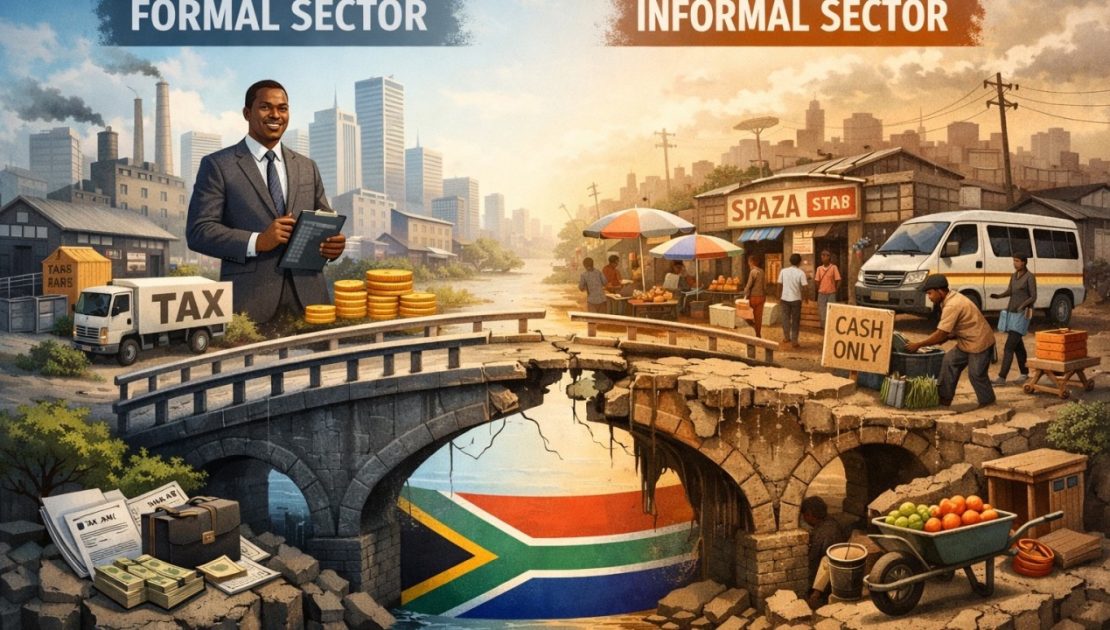
Because we have two economies.
The formal economy is well documented, well-regulated and very visible to the fiscus. It is also, rather inconveniently, responsible for carrying most of the country’s tax burden. That base is narrow and heavily relied upon, which explains why fiscal debates often circle the same group of taxpayers.
But alongside that sits something else entirely.
A vibrant informal economy made up of township retailers, spaza networks, transport operators, construction teams, repair businesses, food vendors and countless other enterprises quietly supporting millions of livelihoods.
If you don’t believe me, just read #Kasinomics by @GGAlcock
Conservative estimates place the informal sector at around 10% of GDP. Some private-sector observers believe it is significantly larger. Anyone who has spent time in township trading nodes will know that meaningful economic activity is happening there every day.
Which raises a rather practical question: why are we trying so hard to create entrepreneurs, when entrepreneurship is already operating at scale?
Formalisation Isn’t a Moral Issue! It’s an Incentive Problem!
There is often an assumption that informal businesses remain informal because they resist regulation.
In reality, most entrepreneurs make a very simple calculation. If the benefits of becoming visible exceed the costs, they formalise. If the costs exceed the benefits, they don’t.
At present, those costs can include paperwork, compliance complexity, licensing uncertainty, and a tax environment that often feels designed for firms with finance departments rather than entrepreneurs with a bakkie, a mobile phone and a determined work ethic.
So while reducing red tape is certainly welcome and long overdue, it will only move the needle IF formalisation becomes economically worthwhile.
In other words, visibility must come with opportunity.
One of the biggest challenges in SME policy is that we treat “small business” as if it were a single category.
It isn’t. A more practical strategy would recognise three very different segments of enterprise:
1. Survival Micro-Traders
These businesses are focused on stability rather than expansion. Their needs are basic but important: safe trading environments, reliable services, storage, and access to simple digital payment systems.
2. High-Turnover Informal Enterprises
This is the group South Africa tends to overlook.
Spaza chains, informal logistics operators, construction teams, small manufacturers and service providers already doing substantial trade — often in cash-based environments that make their scale difficult to measure.
These firms represent the most promising candidates for formalisation and growth. But only if the state offers a credible deal: simplified micro-tax regimes, predictable licensing, access to working capital, and procurement pathways into municipal and infrastructure supply chains.
The sequence matters: Opportunity – Scale – Compliance – Tax
Reverse that order and the policy tends to collapse.
3. Growth-Oriented Formal SMEs
These businesses already exist within the formal economy but face other constraints: access to capital, infrastructure reliability, export enablement, and the administrative burden of compliance.
Each group requires a different approach. Treating them as a single category is a bit like prescribing the same medicine to everyone in the waiting room. Admirably efficient perhaps, but not especially effective.
One noticeable omission in the current SME conversation is meaningful tax simplification for micro-enterprises.
South Africa’s tax base is narrow. Repeatedly leaning on the same compliant group of taxpayers is not a sustainable strategy.
A broader base — achieved by enabling growth and gradually bringing successful informal enterprises into the formal economy — would reduce pressure on the system as a whole.
That isn’t ideological. It’s arithmetic.
Every successful economy continually produces new industrial leaders.
They emerge when institutions function well, education systems produce capable problem-solvers, and entrepreneurial ambition is encouraged rather than quietly discouraged by friction.
At the moment South Africa faces a number of headwinds: infrastructure reliability, education challenges and regulatory complexity among them.
Yet the potential remains extraordinary.
South Africa has recently secured significant international development finance through global partnerships and multilateral institutions.
This capital could simply build infrastructure.
Or with thoughtful procurement design, it could also build domestic enterprise ecosystems that supply, maintain and expand that infrastructure.
In other words, it could help create the next generation of industrialists.
South Africa does not lack entrepreneurs.
They are everywhere — often operating under difficult conditions with remarkable ingenuity.
What we lack is a coherent system that helps those entrepreneurs graduate into scalable enterprises.
The President’s commitment to supporting small businesses is therefore a welcome starting point.
The next step is simply to ensure that our SME strategy reflects the full spectrum of enterprise already operating across the economy.
Because the entrepreneurial energy we need is already there.
We simply need to build the bridge.
#SmallBusiness #SMEs #Entrepreneurship #EconomicGrowth #SouthAfrica #InformalEconomy #EconomicReform #Policy #Leadership #BusinessDevelopment
