
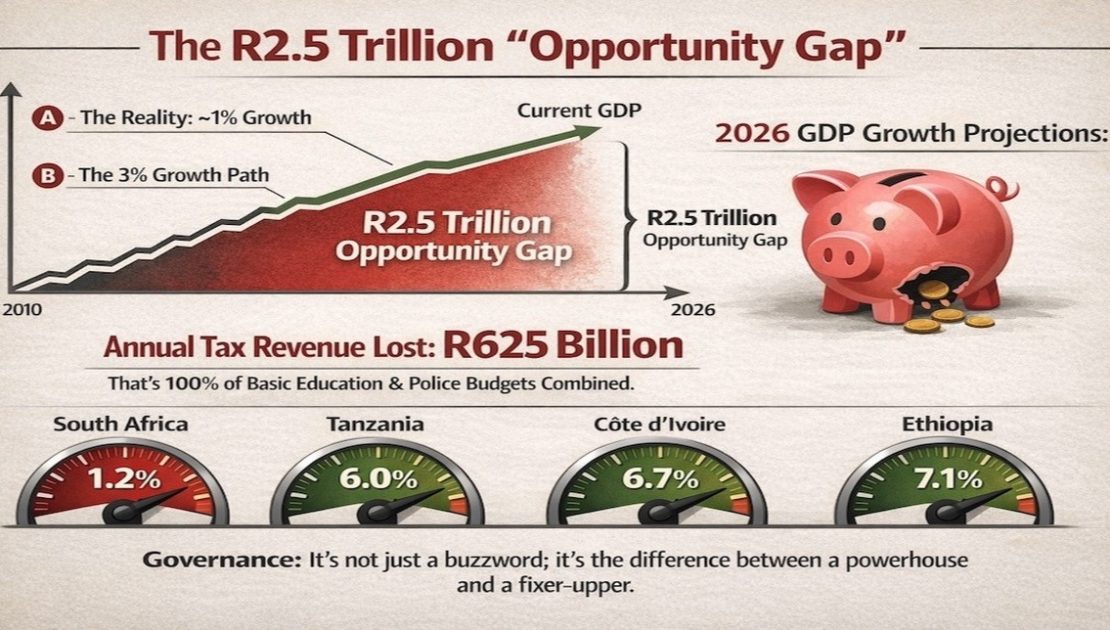
If South Africa were a private company, the shareholders would have fired the Board of Directors sometime around 2012. Why? Because according to the math, we aren’t just “struggling”- we are missing an entire third of our potential economy. I did some back-of-the-envelope calculations on what our country would look like if we had just managed to maintain a “boring” 3% growth rate. The results are… well, let’s call them “ironically expensive.”
There was a time, believe it or not, when South Africa’s GDP growth wasn’t a rounding error. Up until 2010, we were consistently hitting growth rates of 3%, 4%, and even 5%. It was a time when “Loadshedding” sounded like a niche hobby and “State Capture” was something you only saw in Tom Clancy novels.
Then, the wheels didn’t just come off; they were systematically unscrewed and sold for scrap. Over the last 15 years, our growth has slowed to an average of roughly 1%.
I decided to run the numbers: What if we had stayed at 3% due to intelligent economic planning and the kind of governance that prioritizes growth over “creative accounting”?
If South Africa had simply maintained that modest 3% growth rate since 2011—avoiding the chaos of the “lost decade” and the lack of confidence that comes with state capture—our economy today would be approximately 33% larger than it currently is. In real money?
With that kind of “missing” tax money, we wouldn’t just be fixing Eskom; we’d be gold-plating the pylons. We could have funded world-class infrastructure, built dozens of hospitals, and eliminated the need for almost all current international borrowing.
Instead, we find ourselves in the ironic position of a man who burned his own house down for the insurance money, only to realize he forgot to pay the premium—and is now asking the neighbours (the World Bank and Co) for a loan to buy a tent.
While we’ve been patting ourselves on the back for managing 1% growth, our neighbours are playing a different game. Yes, they are growing off smaller bases, but the comparison in confidence and investment is hard to ignore:
Of course, GDP growth isn’t the be-all and end-all, but it is a fairly solid indicator of whether the patient is breathing. If we look at other measurements, the irony of our “management” becomes even clearer:
We often talk about the R1.5 Trillion lost to State Capture as the “big number.” But the real tragedy isn’t just the money that was stolen—it’s the opportunity cost of the growth that never happened.
Corruption is a tax on the future. When you hollow out institutions, you don’t just lose the cash in the vault; you lose the trust of the people who were going to build the next factory, start the next tech hub, or invest in the next mine.
GDP growth isn’t everything. It doesn’t measure the soul of a nation, and it certainly doesn’t tell the whole story of inequality or human dignity. But it is the fuel in the engine. Without it, the car doesn’t move, no matter how much you polish the dashboard.
It’s almost impressive, in a dark sort of way: we have managed to turn a powerhouse into a “fixer-upper” while paying the “contractors” premium rates.
So, here’s the question for the boardroom: At what point do we stop asking for more “patience” and start wondering why we’re paying for a government that can’t seem to keep the lights on or the ledger balanced?
#SouthAfrica #Economy #GDP #Governance #TaxRevenue #BusinessIntelligence #Leadership
Sources & Data References
