
I was recently doing strategy and leadership training with a group of executives from a client company when I realised something interesting.
They spoke confidently about markets, competition, pricing, growth, and “the economy”but when I asked them to define economics itself, the room went quiet.
Not because they weren’t intelligent people. Quite the opposite. It’s simply that most of us interact with economics every single day without ever really unpacking what it means.
So I broke it down in the simplest possible way.
The word economics comes from the ancient Greek “oikonomia” literally “the management of a household.”
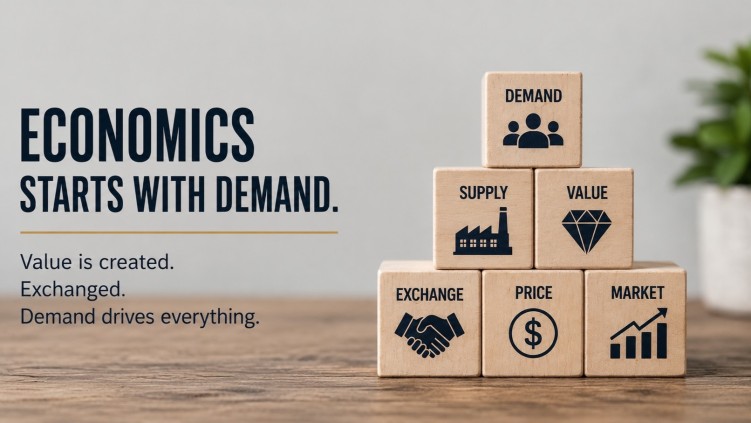
At its core, economics is simply the management of resources, production, trade, and value between people.
That’s it.
Before economics became political, ideological, academic, or weaponised on television debates, it was fundamentally about people exchanging things of value.
And through trade, whether through barter or money, value moves between participants.
That principle still governs the modern world, from multinational corporations right down to the informal bread seller at a taxi rank.
And perhaps most importantly for business owners, economics is ultimately governed by one brutal but beautifully simple reality:
If you produce something people genuinely need or value, demand emerges.
If you don’t, it doesn’t. Everything else is secondary.
This is where many businesses lose their way:
The market, however, is ruthlessly honest.
And this applies equally whether you are Apple, a local engineering firm, or a street vendor selling vetkoek.
Take a simple township example.
If there are two vetkoek sellers on a street corner, both may do well. But if twenty sellers arrive while demand stays the same, margins collapse. Suddenly price, convenience, quality, location, relationships, or innovation become critical differentiators.
That is economics in motion. The same principle governs virtually every industry on earth.
When businesses understand this properly, strategy changes dramatically.
Instead of asking, “What do we want to sell?”
They begin asking:
That shift is profound.
Because successful businesses are rarely built by accident. They are built by identifying, anticipating, or creating demand, then fulfilling it better than others.
This is also why monopolies emerge.
When one or two companies satisfy demand more effectively than everyone else, they dominate markets. But history repeatedly shows that even dominant players can be disrupted when somebody understands changing demand better than they do.
That is the beauty of economics.
It is constantly moving. Constantly adapting. Constantly rewarding those who observe carefully.
And this is why business owners, especially entrepreneurs and SMEs, should spend more time understanding economics, not less.
Not economics as political theatre. Not economics as ideology.
But economics as the living system of value exchange that determines whether businesses survive, grow, or disappear.
Because whether we realise it or not, every business decision we make is an economic decision.
Every hire. Every product. Every marketing campaign. Every pricing structure. Every innovation.
We are all participating in the same system: Trying to create something valuable enough that somebody else willingly exchanges their own value (goods services or money) for it.
And once executives in that training session understood economics this way, something changed.
The conversation became less theoretical and far more practical.
Suddenly they weren’t just “running departments.”
They were participants in a dynamic value system where understanding demand, scarcity, competition, and usefulness wasn’t academic at all, it was directly tied to the survival and growth of their business.
And those who understand that simplest principle often outperform those who overcomplicate it.
To understand how to apply this to your business go here and lets go down the economic rabbit hole together…https://fiverc.com/management-consulting/introductory-evaluation-for-guide/
