
The overnight success. The bold pivot. The disruptive idea that “changes everything.” The dramatic right turn that somehow unlocks explosive growth.
They make for great headlines. They travel well on Social Media. And they create the impression that success in business is driven by big, decisive moments.
In reality, most businesses that endure are built very differently.
They are not chaotic. They are not constantly reinventing themselves. And they are certainly not making radical shifts every time something new comes along.
They are, quite simply, consistent.
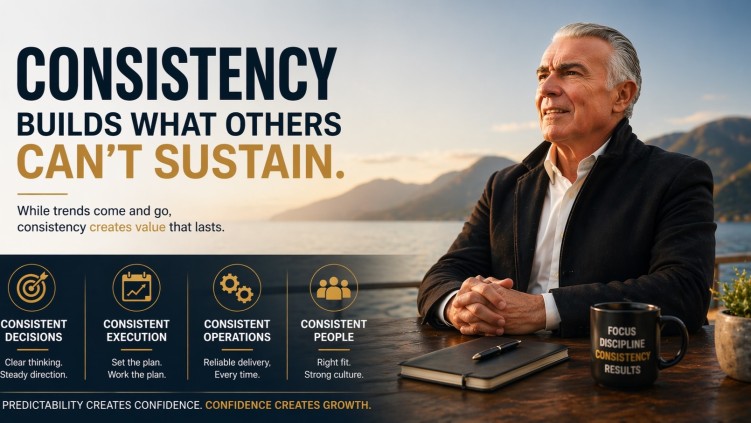
Consistency is not glamorous. It doesn’t trend. It doesn’t feel like progress in the moment. But it is the single most reliable mechanism for building something that actually works—and continues to work.
At its core, consistency shows up in how decisions are made. Not just the decisions themselves, but the way they are arrived at. A business where decisions are predictable in logic, grounded in a clear framework, and aligned with a defined direction tends to move forward with far less friction.
Contrast that with the business where decisions change depending on mood, pressure, or the latest external influence. The latter feels busy, but rarely feels stable.
The same applies to planning. Not the grand annual plan that gets written and then quietly ignored, but the discipline of planning consistently—reviewing, adjusting, and executing against a direction that doesn’t change every few weeks.
When planning becomes a rhythm rather than an event, the business begins to develop momentum. And momentum, once established, is far more valuable than bursts of energy.
Operationally, consistency becomes even more visible. Customers don’t return because of one exceptional experience; they return because they know what to expect. Service quality, delivery timelines, communication, product standards—these are not areas where unpredictability is appreciated. Reliability builds trust. And trust, in most markets, is still the most defensible advantage a small business has.
Then there are people.
For all the advances in technology and automation, businesses are still fundamentally human systems. And humans have a very low tolerance for inconsistency, particularly from leadership.
A founder who is collaborative one day and erratic the next creates uncertainty that quickly spreads through the organisation. People begin to second-guess, hesitate, and protect themselves rather than contribute.
Consistency in leadership behaviour, how you communicate, how you respond under pressure, how you make decisions, creates a kind of psychological stability. And that stability is what allows people to perform at their best.
Hiring, too, reflects this. Businesses that scale sustainably tend to bring in people who align with a consistent way of working, thinking, and operating. Not clones, but individuals who fit a clearly defined environment. Without that, every new hire introduces variation, and variation-unchecked-quickly becomes dysfunction.
What sits underneath all of this is something that is rarely spoken about, but incredibly powerful: predictability.
Predictability has somehow developed a poor reputation, as if it implies stagnation or lack of ambition. In practice, it is the opposite. Predictability is what allows you to plan with confidence, allocate resources effectively, and make decisions based on something more than instinct.
When a business is predictable, you can see patterns. When you can see patterns, you can improve them. And when you can improve them, you start to build efficiency…real efficiency, not just cost-cutting disguised as progress.
The irony is that many of the problems I see in growing businesses are not due to a lack of ideas or effort, but a lack of consistency.
The “enemy” is rarely obvious. It often looks like responsiveness. A reaction to market noise. A new idea that feels too good not to pursue. A shift in direction because someone, somewhere, seems to be doing something interesting.
Left unchecked, these small deviations compound. What was once a clear, functioning operation becomes fragmented. Teams pull in slightly different directions. Customers experience different versions of the same business. Decision-making becomes slower because nothing feels anchored.
And all of this can happen while the business still appears, on the surface, to be doing well.
Which is why consistency is not something you notice when it’s present. You notice it when it’s missing.
If you were to step back and look at your own business, a few uncomfortable questions tend to emerge. Are decisions made in a consistent way, or do they vary depending on the day? Do your customers experience the same level of service every time, or does it depend on who they deal with? Do your people know what to expect from you as a leader, or are they constantly adjusting?
More often than not, the gaps are not dramatic. They’re subtle. But they are enough to create drag. And over time, that drag is what prevents a good business from becoming a great one.
The businesses that endure are not the ones making the loudest moves. They are the ones quietly building systems, habits, and behaviours that produce the same quality of outcome, again and again.
And in a landscape increasingly obsessed with speed and disruption, there is something quietly powerful about that.
If any of this feels uncomfortably familiar, it’s usually worth exploring. Not because something is broken, but because there is often far more potential in the business than is currently being realised, simply waiting for a bit more structure, alignment, and consistency to unlock it.
To explore how we can help you further click here…https://fiverc.com/management-consulting/introductory-evaluation-for-next-step/
#Consistency #BusinessGrowth #Entrepreneurship #Leadership #Execution #ScalingBusiness #SmallBusiness #Discipline #CompanyCulture
